AnTuTu has published its monthly rankings for December today, and as usual there are three categories to get through: flagship smartphones, upper-midrange smartphones, and tablets.
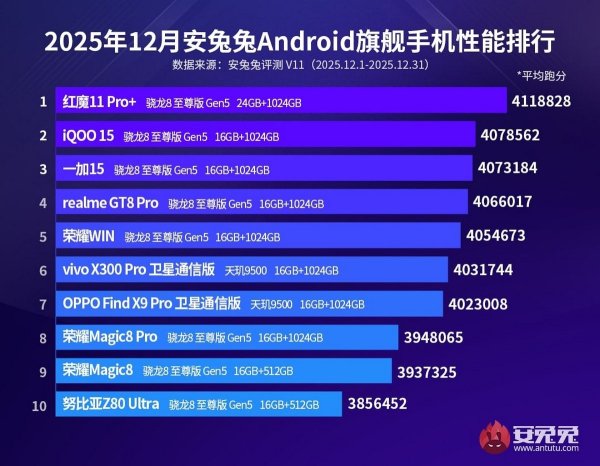
Leading in the flagship realm is the RedMagic 11 Pro+ with an average score of 4,118,828, followed by the iQOO 15 with 4,078,562 and the OnePlus 15 with 4,073,184. In fourth is the Realme GT 8 Pro with 4,066,017, followed by the Honor Win with 4,054,673.

The vivo X300 Pro in sixth place is the first phone using the MediaTek Dimensity 9500 SoC, all of the top five are powered by the Snapdragon 8 Elite Gen 5. The Oppo Find X9 Pro closely follows the vivo with the same Dimensity chipset, and the last three places in the top ten are all powered by the Snapdragon 8 Elite Gen 5 again: the Honor Magic8 Pro, the Magic8, and the nubia Z80 Ultra.
Moving on to upper-midrange phones, the recently launched Oppo Reno15 Pro and Reno15 dominate with their Dimensity 8450 SoC, followed by the Realme Neo7 SE using the Dimensity 8400-Max, the iQOO Z10 Turbo using the Dimensity 8400, and the Oppo K13 Turbo using the Dimensity 8450.
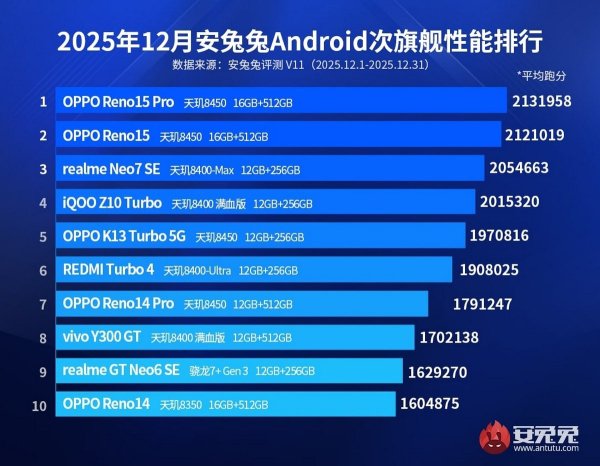
This top ten chart contains nine Dimensity SoC-powered smartphones and only one using a Snapdragon – the 7+ Gen 3 (the Realme GT Neo6 SE in ninth place). This should tell you everything there is to know about how little Qualcomm is focusing on this space, and how much MediaTek basically has it all for itself.
In the tablet chart the winner is the Honor MagicPad3 Pro 13.3 with an average score of 4,033,256. Since this is the only tablet using the Snapdragon 8 Elite Gen 5, its win isn’t at all surprising. It’s followed by the Oppo Pad 4 Pro and OnePlus Pad 2 Pro, both using the older Snapdragon 8 Elite.
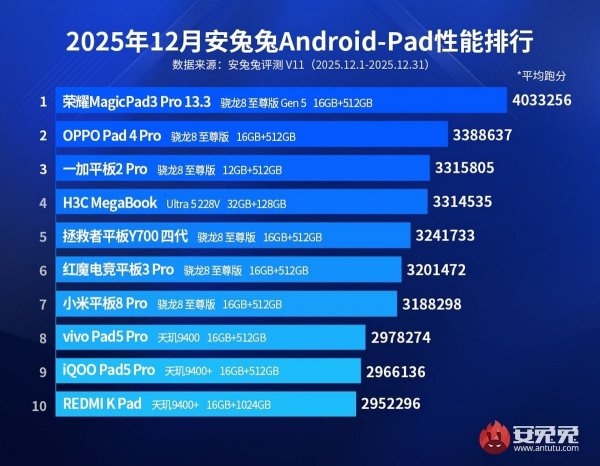
Interestingly, the H3C MegaBook is in fourth, and this one’s powered by the Intel Core Ultra 5 228V. It’s followed by the Lenovo Legion Y700 (Gen 4), the RedMagic Astra, and the Xiaomi Pad 8 Pro, all employing the Snapdragon 8 Elite. Then, in eighth place, MediaTek makes its first appearance with the Dimensity 9400-powered vivo Pad5 Pro, followed by the iQOO Pad5 Pro and the Redmi K Pad, both using the Dimensity 9400+.
Via